
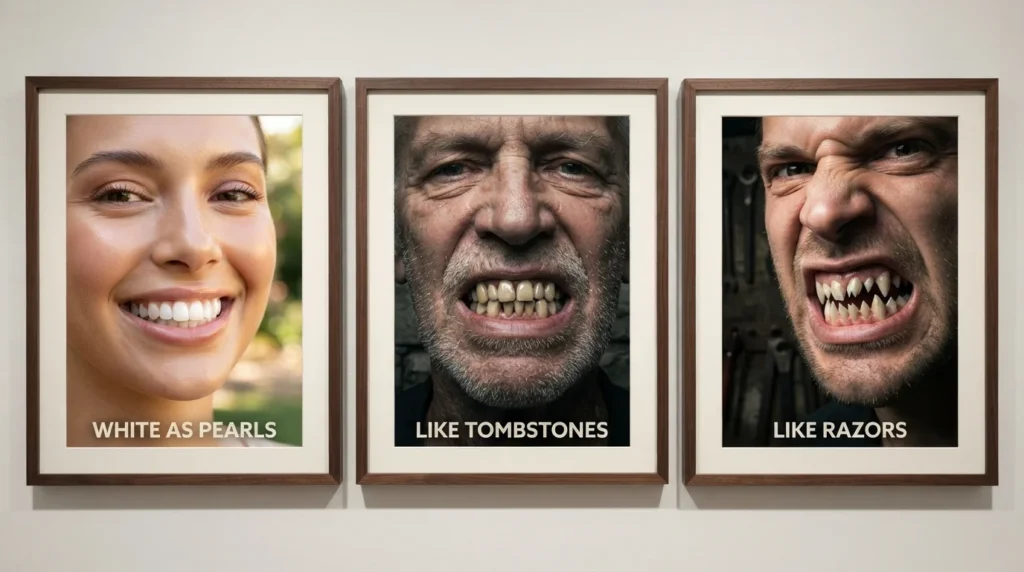

Similes for White Teeth
Bright white teeth are often associated with cleanliness, beauty, and health. Comparisons with pearls, ivory, marble, and snow can emphasize their brightness.
- Teeth like polished ivory
- Teeth like fresh snow
- Teeth like smooth pearls
- Teeth like white marble
- Teeth like polished shells
Example:
Her teeth were like polished pearls, bright against her warm smile.
Similes for Teeth Like Pearls
Pearls are one of the most familiar comparisons for beautiful teeth. They suggest whiteness, smoothness, and elegance.
- Teeth like pearls on a necklace
- Teeth like freshly polished pearls
- Teeth like tiny pearls arranged in a row
- Teeth like pearls shining beneath the light
Example:
His smile revealed teeth like a string of perfectly matched pearls.
Similes for Teeth Like Ivory
Ivory is traditionally associated with a smooth, pale, creamy-white appearance.
- Teeth like polished ivory
- Teeth like carved ivory
- Teeth like tiny ivory blocks
- Teeth like smooth ivory beads
Example:
Her teeth were like polished ivory, neat and bright.
Similes for Teeth Like Piano Keys
The regular arrangement of teeth can resemble the orderly rows of piano keys.
- Teeth like piano keys
- Teeth like freshly cleaned piano keys
- Teeth like little ivory keys
- Teeth lined up like piano keys
Example:
His perfectly straight teeth lined up like the keys of a new piano.
Similes for Sharp Teeth
Sharp teeth can create a threatening or animal-like image. Comparisons with knives, needles, and claws make the description more intense.
- Teeth like sharp knives
- Teeth like needles
- Teeth like tiny daggers
- Teeth like shards of glass
- Teeth like the points of thorns
Example:
The creature opened its mouth, revealing teeth like rows of tiny daggers.
Similes for Animal Teeth
When describing wolves, dogs, lions, sharks, or fictional creatures, comparisons can emphasize strength and danger.
- Teeth like a wolf’s fangs
- Teeth like shark blades
- Teeth like the claws of a predator
- Teeth like polished needles
- Teeth like sharp ivory hooks
Example:
The wolf bared its teeth like a row of curved knives.
Similes for Crooked Teeth
Crooked teeth can be described through comparisons with uneven objects or irregular patterns.
- Teeth like crooked fence posts
- Teeth like uneven stones
- Teeth like a broken picket fence
- Teeth like scattered pieces of a puzzle
- Teeth like rocks in a rough riverbed
Example:
His crooked teeth stood like uneven fence posts behind his grin.
Similes for Yellow Teeth
When describing stained or yellowed teeth, choose comparisons carefully according to the tone of the writing.
- Teeth like old ivory
- Teeth like faded parchment
- Teeth like aged candle wax
- Teeth like yellowed paper
- Teeth like weathered bone
Example:
His yellowed teeth looked like old ivory that had lost its shine.
Similes for Tiny Teeth
Small teeth can be described with comparisons to grains, beads, seeds, or tiny pieces of porcelain.
- Teeth like tiny white beads
- Teeth like grains of rice
- Teeth like little pearls
- Teeth like miniature stones
- Teeth like tiny porcelain tiles
Example:
The baby smiled, showing teeth like tiny grains of rice.
Similes for Big Teeth
Large teeth can make a character or animal appear powerful, unusual, or intimidating.
- Teeth like large ivory blocks
- Teeth like polished stones
- Teeth like the keys of a giant piano
- Teeth like thick pieces of bone
- Teeth like oversized pearls
Example:
The enormous animal had teeth like polished ivory pillars.
Similes for a Beautiful Smile
When the focus is on the whole smile rather than individual teeth, comparisons with light and precious objects work particularly well.
- A smile like sunlight
- Teeth like pearls beneath a bright smile
- Teeth like stars against the night
- Teeth like polished ivory
- A smile like a row of shining jewels
Example:
She smiled, revealing teeth like tiny stars against the darkness.
Similes for Scary Teeth
For horror, fantasy, or suspense writing, stronger comparisons can create a threatening image.
- Teeth like rows of knives
- Teeth like broken glass
- Teeth like the fangs of a giant wolf
- Teeth like sharpened needles
- Teeth like jagged rocks
Example:
The monster grinned with teeth like jagged shards of glass.
Funny Similes for Teeth
Humorous comparisons can make a character’s appearance playful rather than frightening.
- Teeth like piano keys
- Teeth like tiny white dominoes
- Teeth like a picket fence
- Teeth like scattered marshmallows
- Teeth like a row of refrigerator magnets
Example:
He flashed a grin with teeth like a tiny picket fence.
Poetic Similes for Teeth
Poetic writing often benefits from softer comparisons involving light, stars, pearls, and snow.
- Teeth like stars in a dark sky
- Teeth like moonlit pearls
- Teeth like snowflakes in the sun
- Teeth like little pieces of moonlight
- Teeth like silver beads
Example:
Her laughter revealed teeth like little pieces of moonlight.
Creative Similes for Teeth in Different Situations
| Situation | Simile | Effect |
|---|---|---|
| Beautiful smile | Teeth like pearls | Elegant |
| Bright smile | Teeth like stars | Radiant |
| Straight teeth | Teeth like piano keys | Orderly |
| Sharp teeth | Teeth like knives | Dangerous |
| Tiny teeth | Teeth like grains of rice | Cute |
| Crooked teeth | Teeth like fence posts | Humorous or descriptive |
| Scary teeth | Teeth like broken glass | Frightening |
| Animal teeth | Teeth like curved daggers | Powerful |
| Yellow teeth | Teeth like aged ivory | Descriptive |
| Poetic scene | Teeth like moonlit pearls | Dreamlike |
How to Choose the Right Simile for Teeth
Think about the quality you want readers to notice.
If the teeth are beautiful and bright, comparisons with pearls, stars, ivory, or snow work well. If they are sharp or frightening, knives, needles, daggers, and broken glass create a stronger impression.
For funny descriptions, try piano keys, picket fences, or dominoes. For poetry, softer images such as moonlight, pearls, and stars can create a more elegant effect.
The setting and character also matter. A child’s smile may call for a playful comparison, while a monster in a horror story needs something much more threatening.
Common Mistakes When Using Similes for Teeth
One common mistake is using the same comparison repeatedly. “Teeth like pearls” is familiar and effective, but exploring less predictable images can make your writing more original.
Another mistake is choosing a comparison that does not match the character. Sharp, frightening teeth should not be described as delicate pearls unless you deliberately want an unusual contrast.
Also, avoid adding a simile simply because the sentence needs one. A good comparison should reveal something about the teeth and strengthen the overall description.